

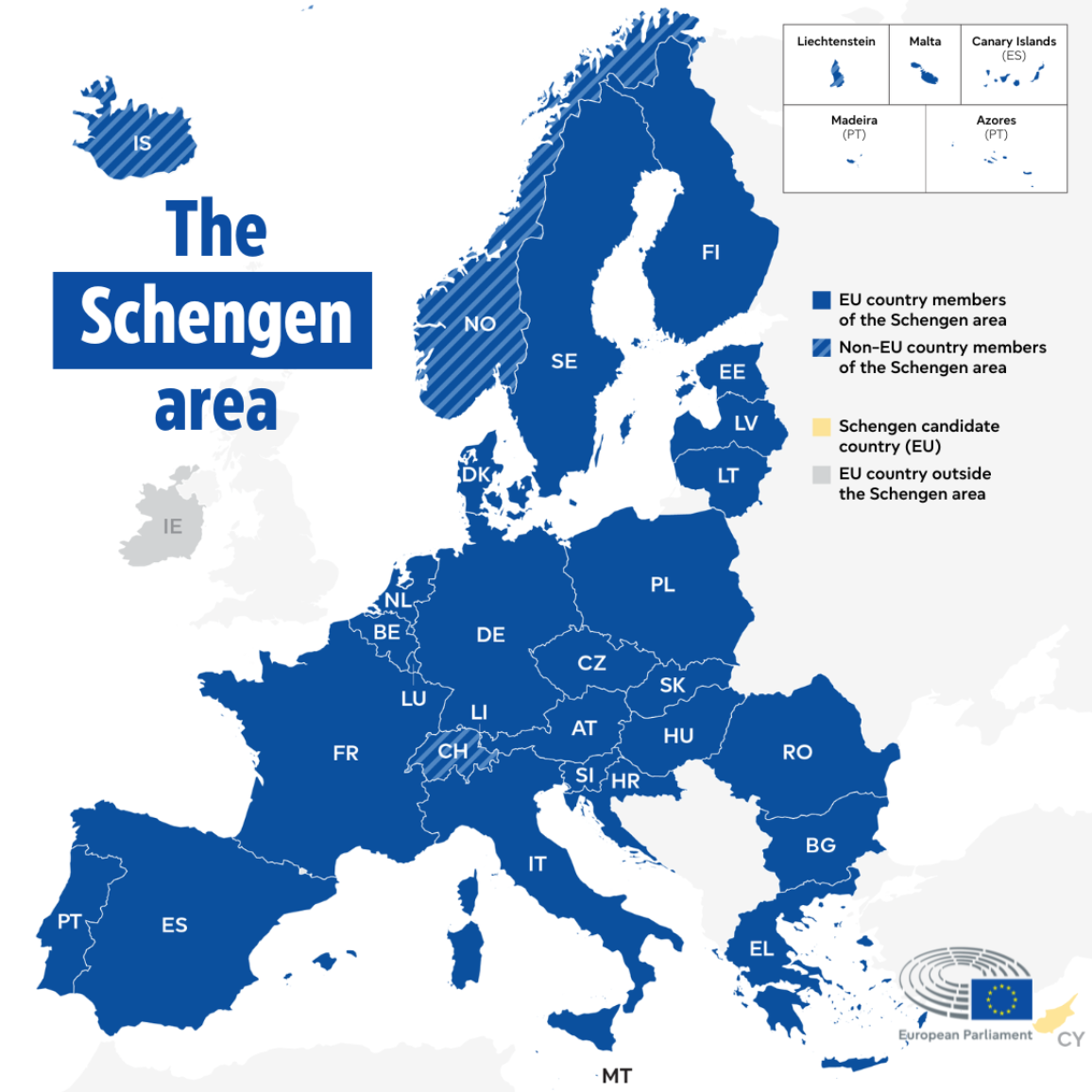
Source: www.europarl.europa.eu
The Schengen area is the world’s largest zone of free movement, enabling more than 450 million people to cross borders between 29 countries without passport controls. For Ukraine — an EU candidate country since June 2022 — understanding and aligning with the Schengen governance framework is a core requirement on the road to full EU membership.
What is Schengen Governance?
Schengen governance is the coordinated system of shared rules, political oversight, and monitoring mechanisms that keeps the borderless area functioning safely and effectively. It is built on two foundational principles: mutual trust — each country trusts all others to manage their portion of the external border to the highest standards — and shared responsibility — every member state is accountable for upholding rights and security across the entire area.
Schengen governance provides both political and operational coordination, based on shared rules, regular monitoring, and close cooperation between national authorities and EU institutions. The framework ensures that common challenges are addressed collectively rather than through unilateral action.
Schengen governance has two main pillars: the Schengen Cycle, with the Schengen Council at its heart, and the Schengen Evaluation and Monitoring Mechanism, coordinated by the European Commission.
Pillar 1 — The Schengen Cycle
Established in 2022, the annual Schengen Cycle provides a structured framework for assessing how Schengen countries implement and comply with common rules. It allows the Schengen Council — the body of Home Affairs Ministers — to swiftly identify key challenges and set priority actions at both national and European levels.
State of Schengen Report
Published annually by the European Commission, this report marks the start of each Schengen Cycle. It assesses how Schengen countries are implementing key policies, highlights challenges, and identifies areas for improvement. The 2025 report, adopted on 23 April 2025, found that while Schengen’s foundations remain robust, persistent gaps exist in border management, return procedures, and police cooperation. It set three priorities for 2025/2026:
- Consolidating the governance framework with stronger political accountability at both European and national level
- Building a structured and coherent approach to police cooperation, including regional cooperation initiatives
- Accelerating the digitalisation of border procedures and systems to increase security and efficiency
Schengen Scoreboard
The Schengen Scoreboard is a transparency tool that visualises the level of implementation of recommendations resulting from Schengen evaluations. It is delivered annually to Home Affairs Ministers to help member states identify where they need to concentrate their efforts. The 2024 Scoreboard found that, on average, countries have implemented between 55% and 60% of open recommendations — indicating many longstanding deficiencies remain unaddressed across the Schengen framework.
Schengen Barometer+
The Schengen Barometer+ provides a situational analysis of the Schengen area based on key indicators: the situation at external borders, migratory flows, internal security, and the situation at internal borders. The Commission presents it to the Schengen Council in March and October each year to steer political decision-making and identify vulnerabilities requiring a joint EU response.
Schengen Council
The Schengen Council brings together Home Affairs Ministers from all Schengen countries to coordinate policies, address common challenges, and ensure proper implementation of Schengen rules. Since 2022, it has met regularly and serves as the central political accountability forum for the Schengen area, replacing ad hoc crisis management with structured, proactive governance.
Pillar 2 — Schengen Evaluation and Monitoring
Coordinated by the European Commission, the Schengen Evaluation and Monitoring Mechanism is the key safeguard for ensuring the effective application of Schengen rules across all member states. By conducting regular on-site evaluations, it identifies areas for improvement and verifies compliance with common standards.
How evaluations work
A new generation of Schengen evaluations was launched in 2023 under a revised Regulation. This approach shifted away from fragmented, policy-specific assessments to comprehensive country-centred evaluations. Evaluations are carried out by teams of experts from member states, coordinated by the Commission and supported by EU agencies including Frontex, Europol, eu-LISA, and the Fundamental Rights Agency. In 2024, a pool of 524 national experts was established for evaluation activities across all policy areas.
The mechanism operates in two phases:
- Evaluation phase: A team of experts visits the member state, carries out on-site assessments, and issues a report with recommendations to remedy identified deficiencies.
- Monitoring phase: The member state reports on progress in implementing recommendations. Verification visits may be conducted to confirm that remedial actions have been completed.
When serious deficiencies are identified, the evaluated state must take immediate action, subject to tighter timelines and closer political scrutiny. A revisit takes place within 12 months. In exceptional circumstances, internal border controls may be temporarily reintroduced under the Schengen Borders Code.
Thematic Evaluations
Thematic evaluations assess the application of Schengen rules across all member states simultaneously in relation to a specific policy area. They offer a foundation for policy decisions and support peer-to-peer learning. Recent examples include:
- A 2024 thematic evaluation on the effectiveness of return procedures for third-country nationals with no right to stay
- A 2023 thematic evaluation on drug trafficking, with on-site visits to the ports of Rotterdam, Antwerp, Marseille, and Hamburg
2023–2029 Multiannual Evaluation Programme
The multiannual programme covers all Schengen members in a rolling seven-year cycle: Finland, Lithuania, Latvia, and Estonia in 2023; Poland, Czechia, Slovakia, Hungary, and Croatia in 2024; Switzerland, Slovenia, Austria, Romania, and Bulgaria in 2025; continuing through all members until 2029. The programme may include periodic evaluations, monitoring visits, thematic evaluations, and unannounced evaluations conducted without prior notice.
Why Schengen Governance Matters for Ukraine
Ukraine received EU candidate status in June 2022 and formally opened accession negotiations in 2024. Full EU membership means full participation in the Schengen area — this is a treaty obligation for all new EU members. Understanding and beginning to align with Schengen governance is therefore foundational preparatory work that cannot be deferred.
Membership requires Schengen compliance
Before internal border controls can be lifted with Ukraine, the country will need to demonstrate — through a Schengen readiness evaluation — that its border management, visa policy, law enforcement cooperation, data protection frameworks, and IT systems all meet Schengen standards. This evaluation itself requires years of prior institutional preparation.
Ukraine’s future external EU border
Upon accession, Ukraine’s extensive borders with Russia, Belarus, its Black Sea coast, as well as Moldova, unless this country joins the EU at the same time or earlier, would become part of the EU’s external frontier. The Schengen framework places specific, demanding obligations on the management of external borders. Building the infrastructure, legal frameworks, and operational capacity to meet these obligations takes years and must begin well ahead of accession.
Law enforcement and police cooperation
Schengen membership involves deep integration into EU law enforcement networks, including Europol, the Schengen Information System (SIS), SIRENE bureaux, and EMPACT (the European Multidisciplinary Platform Against Criminal Threats). Ukraine’s border management and law enforcement agencies need to begin aligning with these frameworks, cooperation standards, and data protection requirements — work that the EU4IBM project directly supports through legal approximation assistance.
Digitalisation of border procedures
One of the explicit priorities of the 2025/2026 Schengen Cycle is accelerating the digitalisation of border procedures and systems. Ukraine will need to integrate with EU systems including the Entry/Exit System (EES) and the European Travel Information and Authorisation System (ETIAS), requiring significant investment in digital border infrastructure, biometric data systems, and interoperability with EU databases.
Economic and mobility benefits
Participation in the Schengen area will eventually allow Ukrainians to travel, work, and study across 29 countries without border checks — a significant economic and social transformation. For businesses, it means seamless logistics and labour mobility across the EU single market. These benefits are contingent on Ukraine successfully completing the governance reforms and readiness evaluations described above.
Ukraine’s Roadmap to Schengen Participation
The path from candidate country to full Schengen participation follows a clearly defined sequence of legislative, institutional, and operational milestones.
| Stage | Key Requirements | Status |
|---|---|---|
| EU Candidate Status | Application accepted; accession negotiations formally opened | ✔ Achieved (2022–2024) |
| Schengen Acquis Alignment | Transposition of Schengen rules into Ukrainian law: border code, visa policy, SIS, data protection, police cooperation frameworks | ● In progress |
| EU Membership | Completion of all accession chapters; ratification by all member states | ○ Future |
| Schengen Readiness Evaluation | Comprehensive on-site assessment by EU expert teams of Ukraine’s readiness to manage the external border at Schengen standards | ○ Future |
| Full Schengen Accession | Council decision to lift internal border controls; Ukraine joins the area of free movement | ○ Future |
